Kiang Malingue is pleased to present a two-person exhibition of new works by Yang Chi-Chuan and Faye Wei Wei at Art Collaboration Kyoto 2026. Marking the Japanese debut for both artists, the presentation highlights their distinct sculptural and painterly practices, tracing subtle affinities with Japanese aesthetic traditions, natural history, and spatial poetry.
Yang Chi-Chuan (b. 1985, based in Taipei) is known for an evocative practice that explores connections between individuals, places, objects, and transient events. Yang trained as a sculptor in Taipei and Paris; for two decades her multidisciplinary practice—drawings, installations, sound pieces—has turned personal narrative inside out, inviting viewers to rediscover overlooked details within everyday life. Sound runs through this practice as much as form: her installations pair sculpture with the artist’s own murmured narration and recorded voices, so that personal memory is heard as much as seen.
Yang’s new ceramics carry this aural sensibility into silence—sculpting silent lullabies. For Kyoto, she presents a group of suspended ceramic sculptures, collectively titled Good night, sweet dreams. Building upon her signature formal language of intricate, chime-like structures, this new series draws inspiration from the artist’s experience of early motherhood. Central to the work is the figure of the bird—a ubiquitous yet frequently overlooked urban detail. Through daily interactions with her infant son, whose fascination with watching birds in flight reawakens her own attentiveness to them, Yang re-examines these avian presences. Made for Kyoto, the works also carry a faint echo of Japanese omamori and temple blessings—offered as gentle wishes for peace and sweet dreams.
Birdy (2026) expands on Yang’s classic curtain-like wind-chime format. Suspended from soft metal strings, ceramic elements depicting birds and organic forms hang in vertical dialogue. Reflecting a perspective shaped by her child’s wonder, these works embody the meditative quality characteristic of Yang’s recent practice: a repetitive, detail-oriented rendering of feathers and organic textures that prioritises tactile presence over scientific fidelity. Rather than pursue zoological realism, these sculptures slow time down—allowing space to contemplate ordinary beauty and the quiet, unconditional bonds of care.
By contrast, Long Long Night (2026) recounts the nocturnal rhythm of motherhood. Incorporating surrealist eye motifs alongside visually heavy, chain-like ceramic elements, Yang articulates the bittersweet reality of night-time vigilance. Here, sleep deprivation is reframed as a cyclical space, its Goyaesque nocturnal images harbingers not of dread but of otherworldly possibility. Works such as Animal forest in dreams (2026), Birds’ sanctuary (2026), and Tree’s cuddle under the moonlight (2026) likewise depart from the series’ signature verticality—adopting forms reminiscent of delicate, porous cradles or complex crib mobiles, yet remaining suspended, part of the same collective body. Rich in symbolism, these sculptures negotiate a precarious balance between the natural and the constructed, gravity and flight, and the intertwined desires to shelter and to break free.
Faye Wei Wei (b. 1994, based in New York) creates luminous, mythic canvases that inhabit the space between painterly gesture, poetic imagery, and romantic narrative. Merging classical European figurative traditions with East Asian visual culture, her practice centres on what she terms an “infection of affection”—a heightened sensibility towards beauty, memory, and emotional longing. Through fluid, expressive mark-making, delicate impasto lattices, and vibrant material experimentations, Wei Wei transforms the canvas into a living skin where the imaginary becomes tangible.
Wei Wei’s new body of work, made specifically for Kyoto, was conceived in her Manhattan studio—its worn, patched floorboards serving as a quiet source of atmospheric inspiration. The suite deepens themes tracing back to her graduate studies, fusing an inquiry into romantic tension with her ongoing engagement with Japanese literary and material traditions.
Revisiting Yasunari Kawabata’s Snow Country, which she read while travelling through Japan, Wei Wei draws upon its iconic scene of collapsed illusions: a woman’s eye reflected in a train window against the snowy night landscape. The synthesis of the surreal and the quotidian mirrors Wei Wei’s approach to painting, where visions of nature, intimacy, and literature entangle. Drawing inspiration also from antique kimonos and the deep surfaces of Japanese tree lacquer, the series functions as an externalisation of inner topographies—a physical manifestation of what Gerard Manley Hopkins called inscape.
In Love (2026), Wei Wei translates the sensory chaos of romance into a shimmering visual membrane. Built using thick impasto oil paint, a delicate lattice resembling lace, snowfall, and scattered stars overlays a neutral ground of bruised purples and deep browns. Informed by Edmund Burke’s observation that “the starry heaven, though it occurs so very frequently to our view, never fails to excite an idea of grandeur,” the painting links the sensation of being lovestruck to sideration—being struck by a star, in both senses of the word. Through shimmering gold chroma, the canvas makes the lover’s interior landscape visually manifest.
Taking inspiration from Japanese lacquer traditions and Wei Wei’s personal collection of antique kimonos, Lacquered Box (2026) explores how garment, object, and surface frame colour. The composition echoes the fluid drapery of kimonos as they sit on the body, with intricate floral motifs weaving in and out of one another in otherworldly palettes. Framing these vibrant hues are deep, dark tones inspired by Japanese black tree lacquer—a rich background that lassoes the surrounding colours, heightening their radiance and evoking the luminous depth of traditional lacquered wooden vessels. Also evoking the intricate craftsmanship of Japanese carved cinnabar and red lacquer boxes, Red Thicket (2026) presents a romantic contemplation of nature as a window into the inner world. To achieve its striking intensity, Wei Wei used distemper, an ancient technique in which raw pigment is mixed with a rabbit-skin glue binder. The resulting vibrant red chroma forms an intricate, swooping veil across the surface, reminiscent of ancient Japanese uta-e, where symbolic landscape scenes serve as visual illustrations for poetic contemplation.
Art Collaboration Kyoto 2026 | KM01 Yang Chi-Chuan, Faye Wei Wei
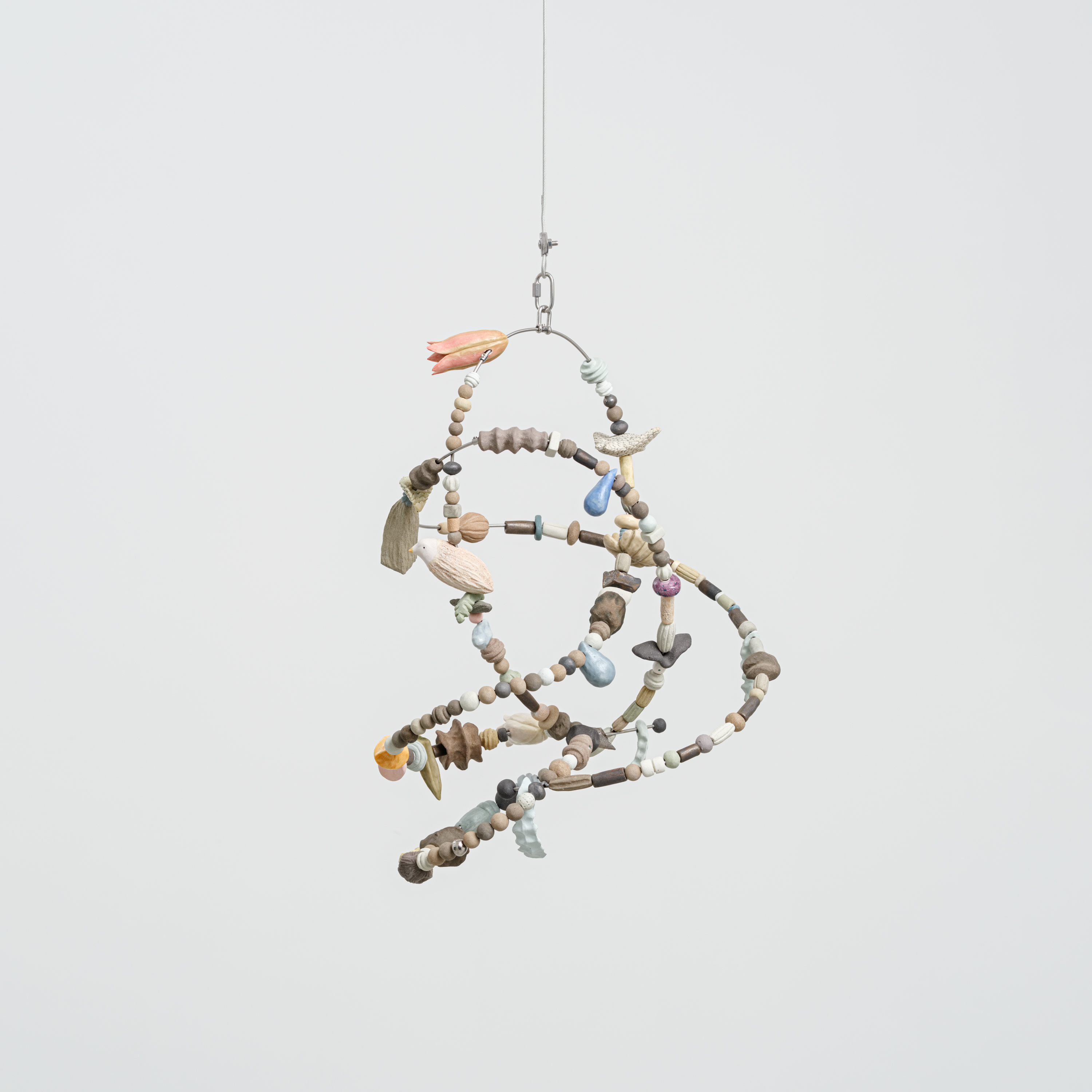
Yang Chi Chuan, Birds’ Sanctuary, 2026. Ceramic, Color powder, Glaze, Underglaze, Stainless Steel, 39 x 28 x 50 cm; 15 ⅜ x 11 x 19 ¾ in.
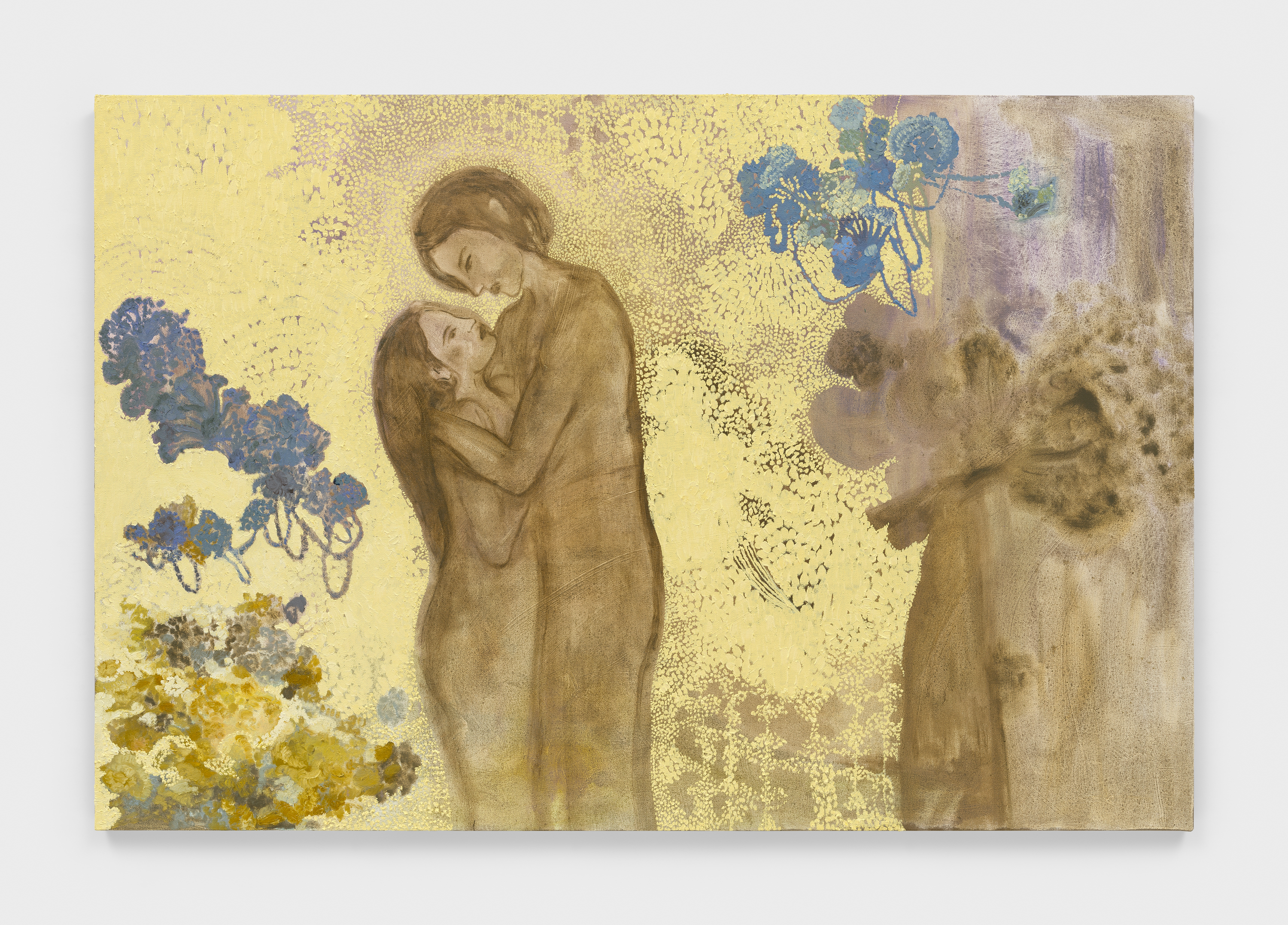
Faye Wei Wei, Love, 2026. Oil on canvas, 122.5 x 183 cm; 48 ¼ x 72 in.