Kiang Malingue is pleased to present LOTTO, an exhibition of new paintings by Henry Curchod, at the gallery’s New York location. The exhibition is accompanied by a text by John Douglas Millar.
Notes or a Constellation for Henry Curchod’s LOTTO
1. A statement: Henry Curchod’s art is generous. Now what to make of that? What kind of generosity is this? It is an art that embraces facility but not hierarchy. It is generous in the manner of a banquet: try a little of this, no this, this too, there’s something hidden over here, it may be exquisite, or simply surprising, or not much of anything. It is a whole poetics, associative, open to sudden beauty, an echo chamber of reference, a choreography of opacities and sudden clarities, like water. Unmappable. Funny, too.
2. On the wall in Curchod’s studio are a number of humble ex-voto paintings by unknown artists. An ex-voto can be a form of thanks and devotion toward a god or gods who have interceded in the mortal realm—praise be to you for stopping my migraine, saving my leg, giving me a child, a harvest, a painting—or it can be a call upon them to do so. A discarded Lotto ticket or scratch card is much the same thing, the tattered paper with its circled numbers lying crumpled at curbside is a serious document of human desire and belief—a belief or faith that one can pull the forces of the universe toward you, have them do your bidding for one perfect moment of material transcendence. It’s a dangerous game, that kind of sincerity. You might want to veil it. It can burn.
3. ‘Votive images,’ writes Georges Didi-Huberman, ‘are organic, vulgar, as disagreeable to contemplate as they are abundant and diffuse. They cut across time.’ They sit outside and challenge ‘normative art history.’ And here, from the same paragraph, a sentence that lights up like neon when I look at Curchod’s work: ‘Votive forms are capable of both disappearing for a very long time and reappearing when one least expects it.’[1] They submerge in time, remerge when called upon by desire or by pain.
4. Boundaries dissolve on the open sea. You see things that may or may not be there. It is a territory of death and transcendence that invites superstition. Bananas onboard a boat are bad luck, a coin beneath the mast is good, sailing on a Friday should be avoided. My father used to tell me not to cut my fingernails on a Sunday or I’d go to the moon. I associated this with the crescent shape of the cuticles, but thinking about it now, I suspect this has nothing to do with it. ‘White room whose walls, / having neither planes nor curves nor angles, / are composed of a continuous satiny white membrane // like the flesh of some interior organ of the moon.’[2] That silver surface, a runway for light. Scratch it.
5. These works are always about risk, and they are a risk.
6. Michel Foucault in his introduction to Deleuze and Guattari’s Anti-Oedipus: ‘The strategic adversary is fascism….the fascism in us all, in our heads and in our everyday behavior, the fascism that causes us to love power, to desire the very thing that dominates and exploits us.’[3] I firmly believe Henry Curchod’s paintings are a spit in the eye of power and ideology; they refuse it, they are opaque, they refuse to be mapped in a world of brutal cartographies, and they mourn those who try to become more than data or human refuse. The wrecked boat, the lamb. Say it: these are anti-fascist paintings.
7. Sitting in one of the cafés that line the Rue de Dunkerque outside the Gare du Nord in Paris, Henry and I are having a drink. Talking about what he loves and hates—Soutine loved, Richter hated, passionately. He leaves the table for a while and comes back with a pile of Lotto tickets. The guy who runs the café and who claims to have Kurdish roots, like Henry, wishes him good luck. Henry places his cigarette in an ashtray and looks at him. ‘If you give us a round of drinks on the house, I’ll give you half of whatever I win.’ The guy laughs, then scoffs, then looks a little confused, angry. Strange moment when the forces that Henry’s art grapples with were suddenly in play. Faith, will, chance, desire, roots and rootlessness, art history. He didn’t give us the drinks, Henry didn’t win, and yet, here is an exhibition called LOTTO. They weren’t losing tickets.
8. Later Henry showed me one of the rugs that is now in this show. At the bottom is a phone number, an actual phone number, try it, that contains the number 666, number of the beast. I looked up, and this is no lie, I looked up and at the back of the bar was a neon sign 6,66. Tremor in the spine and a half-remembered poem by Baudelaire, ‘Nature is a temple in which living pillars / Sometimes give voice to confused words; / Man passes there through forests of symbols / Which look at him with understanding eyes. // Like prolonged echoes mingling in the distance / In a deep and tenebrous unity, / Vast as the dark of night and as the light of day, / Perfumes, sounds, and colors correspond.’[4]
— John Douglas Millar
(About Henry Curchod)
Henry Curchod (b. 1992, Palo Alto, USA) is an artist based in London whose practice moves between figuration and abstraction, and through an interplay of depth and surface, representation and substrate, in drawing and painting. Personal memory and the complexity of the self, everyday objects and encounters, and art and artifacts inform Curchod works, of oil stick on linen, canvas, and stainless steel, as well as fabric dye on Iranian wool rugs connected to the artist’s Kurdish heritage. His compositions, characterized by unanchored forms, shifting perspectives, and raw, gestural markings, appear to emerge from fragments of time, narrative, dream, and history, allowing for multiple meanings to coalesce without a fixed resolution.
Recent solo exhibitions include Kiang Malingue, New York; The Intermission, Athens, Greece; Clearing, Los Angeles and New York; Gallery Vacancy, Shanghai; Shoot the Lobster, New York; and Mamoth, London. His work is held in collections including the Buxton International Collection, Melbourne; Green Family Art Foundation, Dallas; M Woods Museum, Beijing; Sifang Museum, Nanjing; START Museum, Shanghai; Dangxia Foundation, Beijing; Tiantai Museum of Art, Qingdao; and X Museum, Beijing.
[1] Georges Didi-Huberman, ‘Ex-Voto: Image, Organ, Time,’ L’Esprit Créateur, Volume 47, Number 3, Fall 2007, p. 7.
[2] Anne Carson, Glass, Irony, and God (New York: New Directions, 1992), p. 35.
[3] Michel Foucault, ‘Preface’ in Gilles Deleuze and Félix Guattari, Anti-Oedipus: Capitalism and Schizophrenia (New York: Viking Press, 1977), p. xiii.
[4] Charles Baudelaire, Flowers of Evil, trans. William Aggeler (Fresno: Academy Library Guild, 1954), p. 55.
Henry Curchod: LOTTO
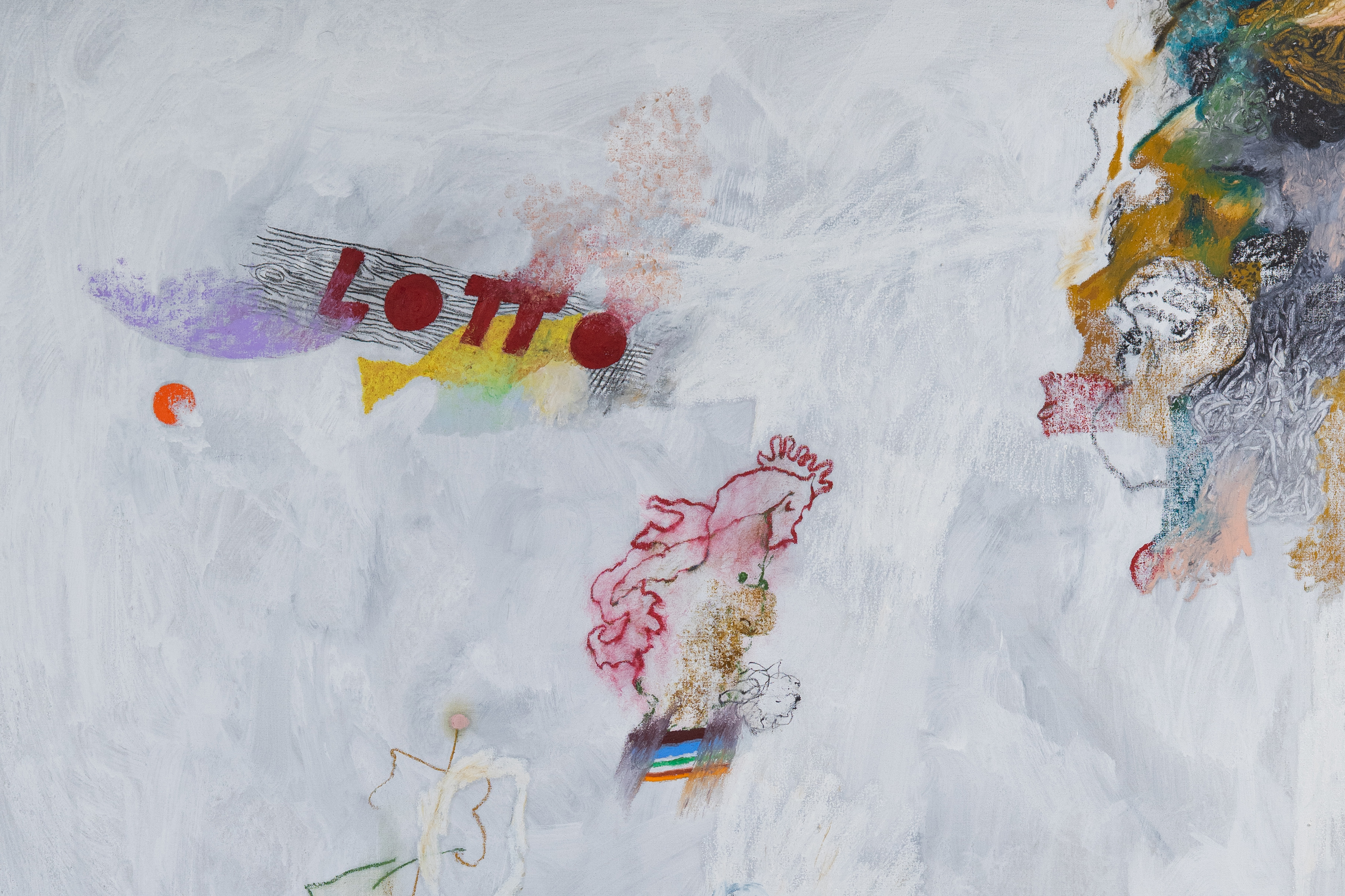
(Details) Henry Curchod, Set for life, 2026. Oil stick, spray paint, gouache and charcoal on linen, in artist’s frame.
79 ½ x 67 ¾ in; 202 x 172 cm.
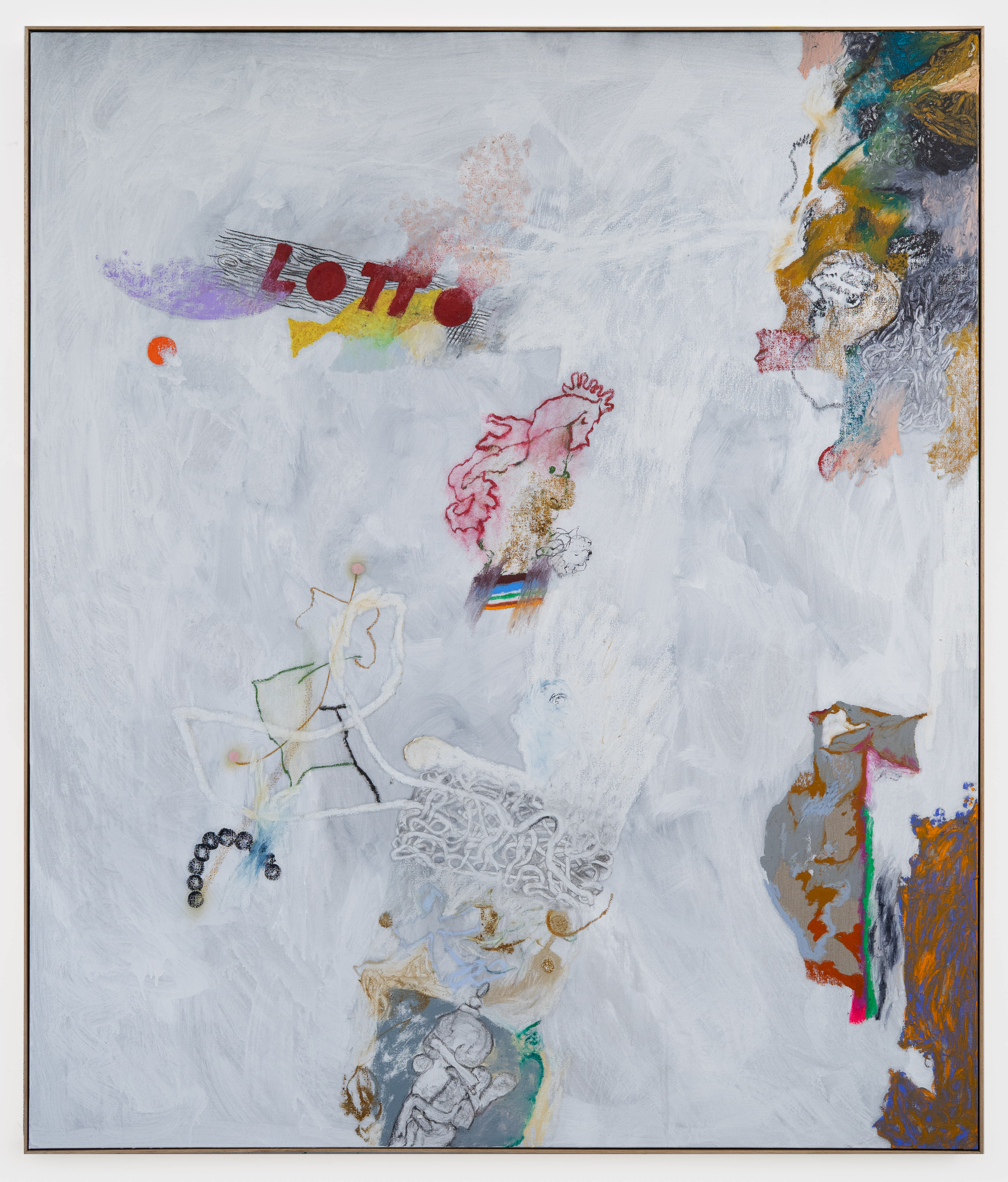
(Details) Henry Curchod, Set for life, 2026. Oil stick, spray paint, gouache and charcoal on linen, in artist’s frame.
79 ½ x 67 ¾ in; 202 x 172 cm.