Kiang Malingue is pleased to present at the Independent Art Fair, New York City, a solo project of Taiwanese artist Tseng Chien-Ying, from May 14–17, 2026. For his U.S. debut, titled Melancholy of Imperatives, Tseng includes ink brush and gouache paintings on paper that reinvent classical techniques, focusing on the body and its fragments as a microcosm and an interface through which the world is perceived and constructed, and as a manifestation and reflection of contemporary life.
Using ink, gouache, and mineral pigments derived from East Asian painting traditions, and moriage technique (raised, three-dimensional decorative technique used on ceramics and murals) with gold and silver leaf, and black foil, on a variety of Asian papers, Tseng has developed a distinctly contemporary visual language. He infuses human form and flesh with an emotional intensity, and the quotidian with an erotic charge. Unlike ink painting, the history and discourse surrounding color-based traditions remain relatively under theorized, despite their deep entanglement with geopolitics in East Asia since the early 20th century. Tseng states, “The material itself carries an organic presence: the granularity and luminosity of mineral pigments resemble gemstones or pearls, while the surface of handmade paper retains traces of its origin, like a terroir embedded in matter. The breathable quality of the medium allows colors to settle into the paper rather than sit upon it, producing a softness akin to skin, as a dialogue between body and material. Painting becomes less an act of control, and more of a negotiation.”
Tseng’s practice draws fluidly from Taiwanese and/or transcultural pop cultural iconography and literary classics, activating synesthesia through organic and vibrant shifts of colors, lines, and contours. Body politics, from body modification to fetish, informs Tseng’s cosmology of flesh, transmuting a raw sensuality on the brink of transformation. In Horizon (2026), the seductive, abstracted shape of a curved back and shoulder forms a mountainous range, bathed in a sumptuous light spectrum horizon, intertwining shifting perception and desire. In Tacit Bouquet (2026), a long-stemmed floral bouquet bursts behind a tenderly portrayed male naked physique, surging with uncontainable and unspoken yearning.
Eschewing the body as a unified subject, Tseng isolates its gestures and actions, as fragments oscillating between image and sensation. The Hand series (all works 2026) depicts everyday actions tied to the maintenance of the body, such as applying eyedrops in Irrigation (2026), or putting on a contact lens in Refraction (2026). Here, bodies undergo constant care and optimization, and the ritualized and mediated acts of vision are hinged on quotidian tender moments of vulnerability and supplication. This fragmentation of the body references an early work, Thousand Hands Project–The First Hundred (2010), of a deconstructed Thousand Hand Guanyin, the bodhisattva of compassion, whose each hand is a manifestation of contemporary desire, for wealth, health, and status. Splat (2026) depicts a thumb squashing a mosquito, and can be seen as a visceral form of normalized and latent violence writ large, and the minimizing of sanctioned aggression. In Excoriation (2026), the condition of dermatophagia, repetitive finger biting of cuticles resulting in peeling skins, is transformed into flowering blooms, thus turning anxiety into ornamentation, erosion into growth, and pain into beauty.
Tseng considers his work as a form of writing, a poetic system that probes contemporary conditions, politics, and collective psychology, and as a language that undergoes constant transformation: “My artwork is a form of rhetoric.” The anatomy of the hands operates as verbs, suggestive of a process of merging forms, between the individual body and an invisible external force. Further amplifying the concept of the “Imperative,” as in imperative verbs that give direct address of instruction, request, advice, and warning, are notions and acts of commitment and necessity. An open palm in Attunement (2026) takes on a sculptural quality, transformed into an undulating topography made up of crescent-like shapes echoing the moon on its upper right, evoking a cosmic attunement. In Iridescence (2026), an elongated hand with additional phalanges seems to reach towards something beyond that cannot be fully grasped. The hand can also operate as an organ of vision, enabling both internal and external perception. Singularity (2026) depicts a hand in vibrant yellow, red, and pink against a field of blue, its thumb and forefinger forming a narrow aperture, reminiscent of pinhole projection that allows for the safe viewing of solar eclipse. In Illumination (2026), the gesture of striking a match protected within shielded hands, with colors manifesting an auratic energy, transforms light and heat into a psychological field of perception.
Addressing the social regulation of the body, Tseng turns to body modification, from body art to male circumcision, and the complex lens of social, cultural, and religious rituals of belonging from which these practices emerge, in particular to their intersection with queer desire and identification. In the diptych Ornamentation #1 / #2 (2026) and the single panel work Ornamentation #3 (2026), Tseng depicts various face piercings by adorning the paper itself with glistening reliefs, by applying the moriage technique on paper. Body piercing, with its coexistence of adornment and penetration, beautification and risk, is a form of inscription on the body, a site where “culture and desire intersect, forming a dialectical relationship between vanity, self-identification, and bodily perception.” In Punctum (2026), a needle’s contact with flesh, perhaps a medical procedure or intervention of a blemish, magnifies the sensation of pressure into a psychological experience of being touched and pierced. To be or not to be (2026) is a diptych painting-sculpture held within a double frame that resembles a locket, depicting two penises, circumcised and uncircumcised. The work explores how cultural and religious norms intersect with sexual preferences, desire, differences, and their attendant power dynamics, and undercuts it all with humor, through the form of a sentimental keepsake.
Independent Art Fair | Booth 218 Tseng Chien-Ying
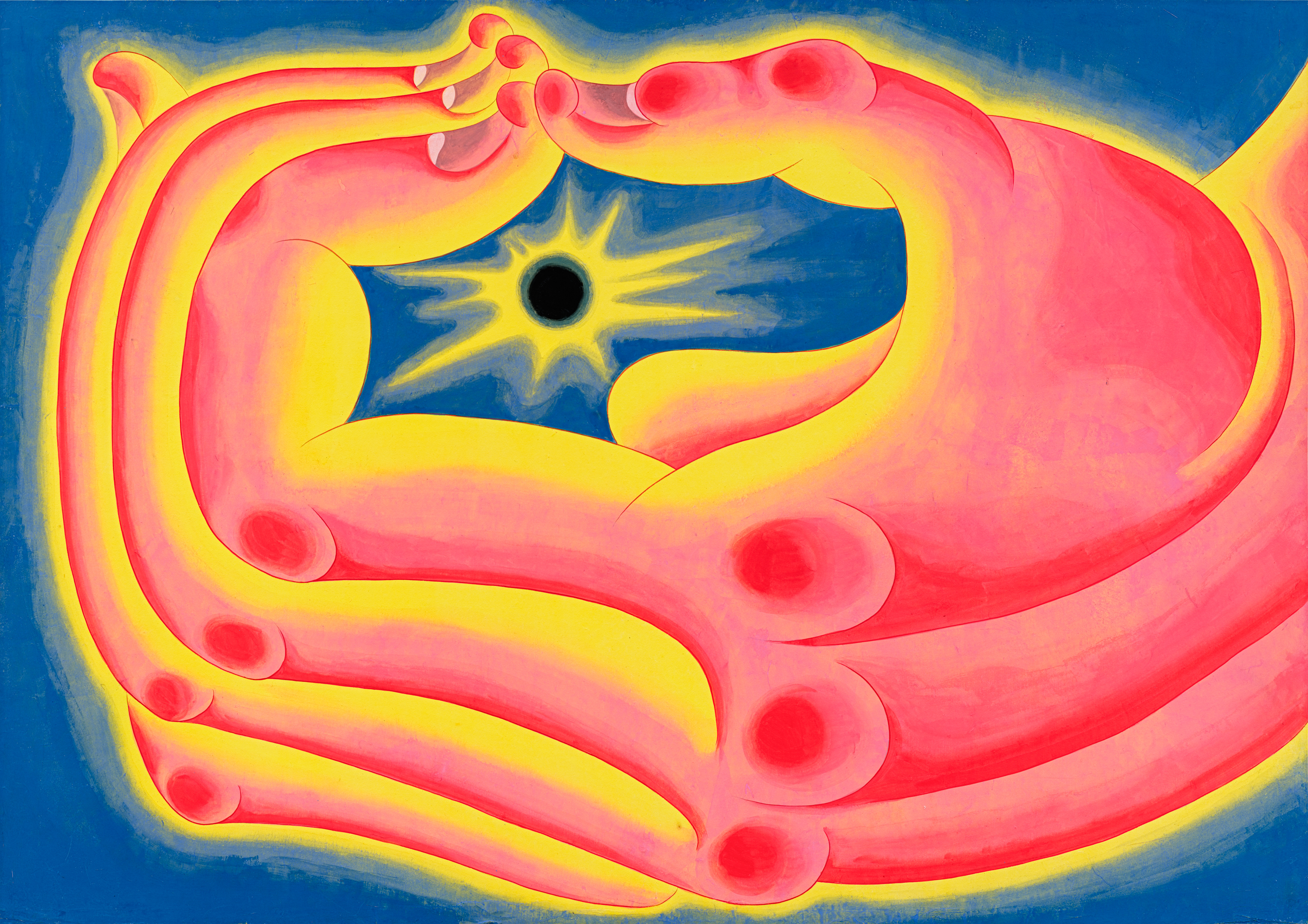
Tseng Chien-Ying, Singularity, 2026. Ink and colors on paper, mineral pigments, 76.5 x 108.5 cm.